Simplifying time off management with AI
As the UX Lead for the redesign of Time Off and Leave, a core feature within Amazon’s internal intranet, I lead efforts to improve how employees manage their time off, leaves, and balances.
A key innovation in progress is the integration of an AI-powered assistant, designed to provide personalized guidance at scale and improve how employees navigate their time management needs.
This project is currently in the design validation phase. While we don’t yet have conclusive impact metrics, the problem we’re addressing is clear and supported by strong user data. The decisions showcased here are based on extensive research and collaboration with stakeholders.
My role
Interaction design | Design strategy | Prototyping | Usability testing | Design QA
Impact and results
This redesign initiative impacts daily operations across Amazon’s global workforce, improving how employees manage their time off.
Currently, the platform generates a significant support burden, with over 100 monthly tickets and more than 1,000 walk-up inquiries across 30 sites.
Hourly and salaried user base
1.6 million global employees
Tickets created monthly for information requests
100
Time off and leave requests processed in 6 months in the US
49,550,242
Walk-up inquiries across 30 sites
1,000
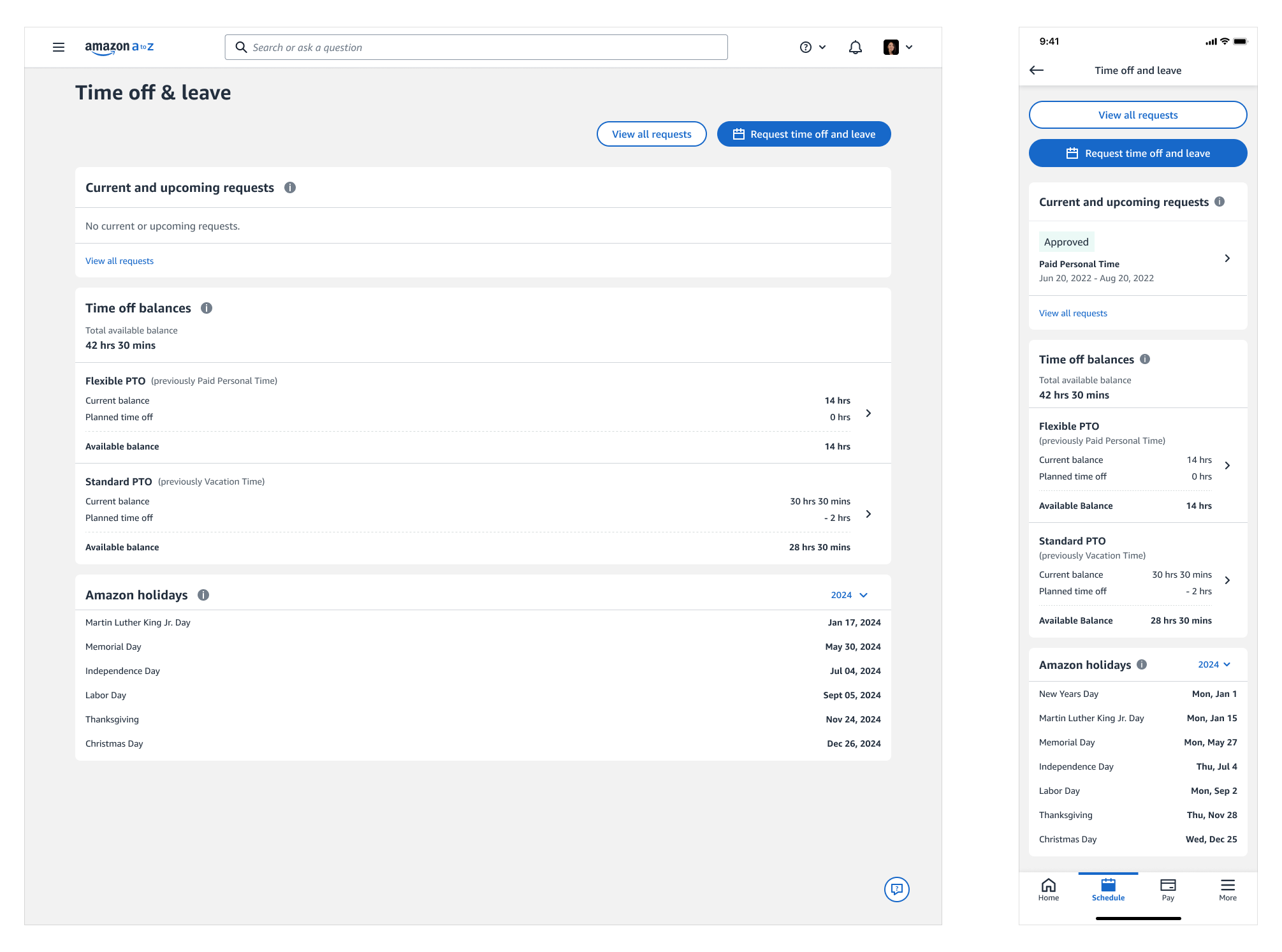
Current design
Design challenge and goals
The Time Off and Leave features needed modernization as employees struggled with visualizing requests, managing leaves, understanding accruals, and interpreting balances, which triggered numerous support tickets and HR walk-ups. The platform's fragmentation across regions, with varying policies and third-party dependencies, further complicated time management.
Our goal is to create a unified, intuitive platform that replaces fragmented systems and addresses key pain points, such as the lack of calendar functionality and supporting content. We focus on four core objectives:
Streamline the time-off request workflow by reducing clicks to completion
Improve transparency in leave management through clearer visualizations
Enable self-service to reduce support tickets and walk-up inquiries
Deliver a consistent experience for all employee types
Design spotlight
For the MVP, we’re focused on designing core experiences that will deliver immediate value to customers managing their time off. Key areas include the homepage experience, time-off request workflows tailored to different customer types, detailed balance views, and the ability for hourly employees to replace missed work hours with time-off requests. Alongside these core flows, we also explored AI-powered conversations to make managing time off easier, faster, and more intuitive.
Comparison of the original and redesigned balance details pages. The updated version adds projected balances, a year-to-date summary, and flexible ways to view balance history through lists, aggregated summaries, and graphs, helping employees manage their time more confidently.
I designed a series of AI conversation flows showing how customers can interact with an AI assistant to manage their time off. In this example, the AI suggests ideal travel times by analyzing public holidays and user preferences, making planning faster and more personalized. Other conversation examples included checking current time-off balances, learning how to complete time-related actions in the app, forecasting accrued time, and requesting time off.
Requesting time off, along with viewing schedules and timecards, is one of the most frequently used features in the app, making it crucial to ensure a seamless and intuitive user experience.
Providing clear definitions and guidance on time-off terminology enhances employee confidence and facilitates more informed decision-making.
The ability to view projected balances and plan for future time-off needs is invaluable for employees managing their schedules effectively.
Offering diverse options for viewing balance history, such as lists, summaries, and graphs, caters to varying user preferences and enhances accessibility.